
Singin’ in the Rain: From Hollywood to the Stage
From Gene Kelly’s unforgettable 1952 film to new productions in Paris and across the UK and Ireland, the story continues to find new ways to make a splash.
For me, Gene Kelly stepping into the rain, opening his umbrella and dancing down the street is one of the most memorable scenes in cinema.
I can never hear “Singin’ in the Rain” without immediately thinking of that moment. The rain, the umbrella and Kelly’s smile create a scene that still makes me smile every time I watch it.
Released in 1952 and directed by Gene Kelly and Stanley Donen, Singin’ in the Rain takes us back to Hollywood in 1927, when silent films are beginning to give way to talking pictures. Don Lockwood, one of Hollywood’s biggest silent-film stars, has to adapt to a new era, while his glamorous co-star Lina Lamont discovers that the arrival of sound presents a problem her screen image never had to solve.
I love the way the film turns such a major change in cinema history into comedy, music and dance.
And then, of course, there is the rain.
Gene Kelly’s title number looks completely effortless, even though he performed it while ill with a fever. The sequence was filmed not on a real city street, but on one of MGM’s outdoor backlot streets, transformed into night with tarpaulins and carefully lit artificial rain. More than seventy years later, it remains one of the images most closely associated with Hollywood musicals.
From Film to Stage
The stage version arrived in London decades after the film had already become a classic.
What I find particularly interesting about Singin’ in the Rain on stage is that it has to recreate the magic of a film without relying on the camera.
And nowhere is that challenge more obvious than in the title number.
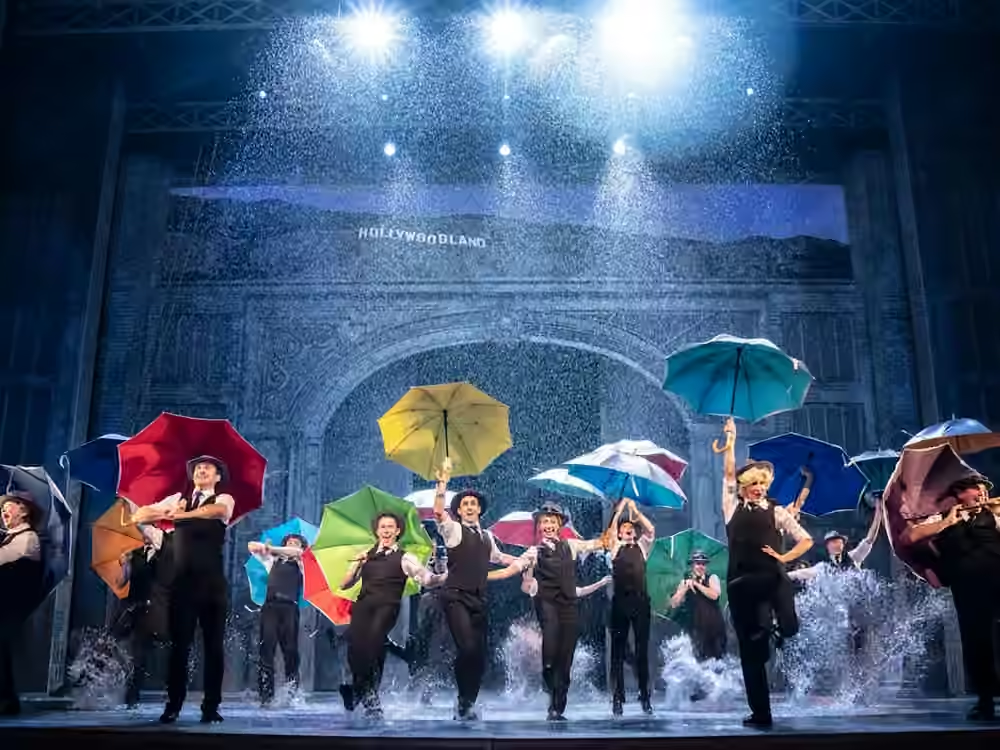
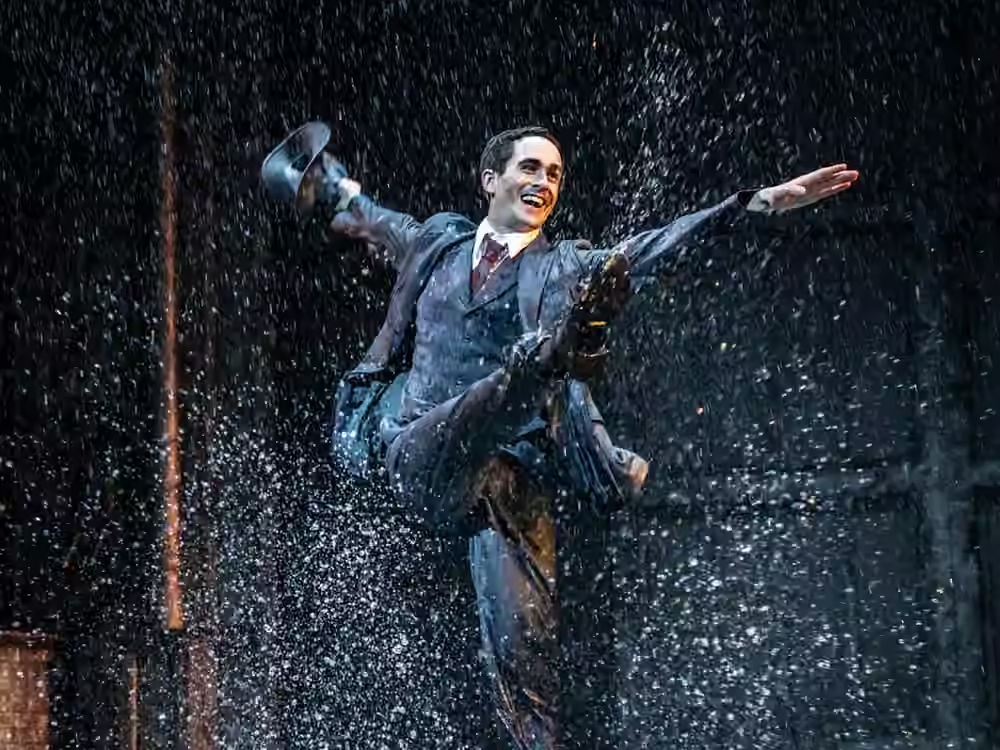
On screen, the camera can follow Gene Kelly through the street and make the rain feel almost intimate. In the theatre, performers have to create that same sense of freedom in front of a live audience – with real water falling onto the stage.
That immediately gives the scene a different energy.
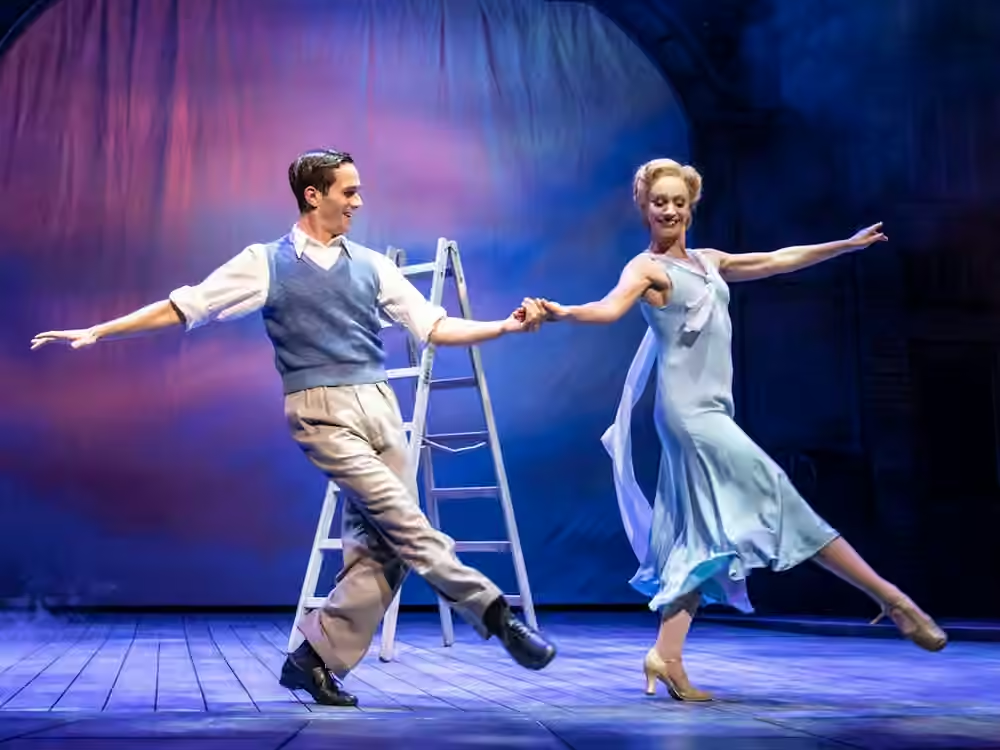
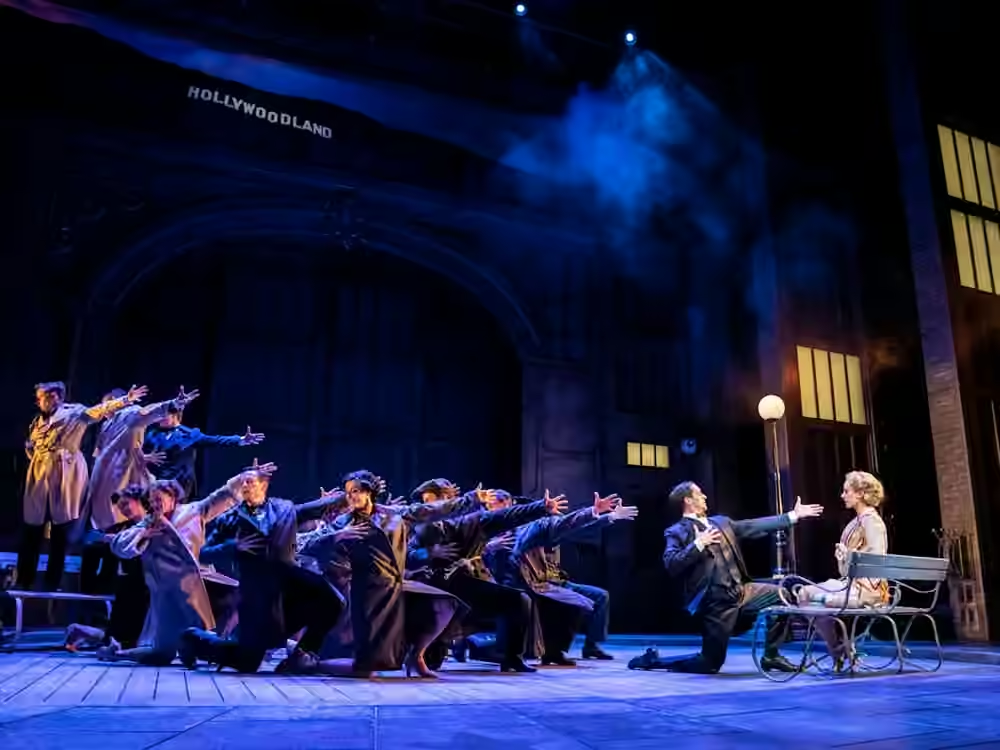
It is also why I enjoy seeing how different directors, choreographers and performers approach a story that audiences already know so well. The songs and characters may be familiar, but theatre gives them the chance to feel new again.
A New Singin’ in the Rain in Paris
That is especially relevant now.
A new production of Singin’ in the Rain, directed by Robert Carsen, opened at the Théâtre du Lido on the Champs-Élysées in Paris in September 2026 and runs until 10 January 2027.
The production is performed in English with French surtitles and a live orchestra. Robert Carsen directs, with choreography by Rebecca Howell.
Ashley Day plays Don Lockwood, with Maddie Waller as Kathy Selden, Charlie Waddell as Cosmo Brown and Natasha O’Brien as Lina Lamont.
I am particularly curious about this production because Paris gives the musical another setting in which to reinvent itself.
The story may be rooted in old Hollywood, but the challenge is always the same: how do you make something so familiar feel alive for an audience watching it today?
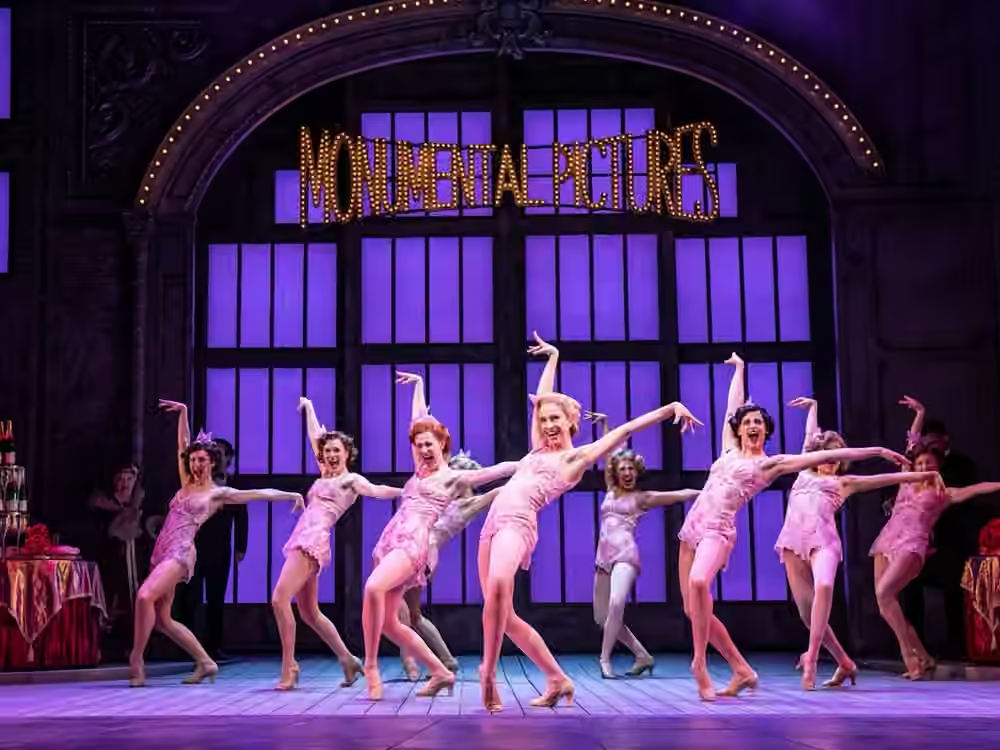
With live musicians, a large company and a production built around dance, spectacle and the famous rain sequence, the Lido version has another opportunity to answer that question in its own way.
Back to the UK – and Into the Rain Again
Another major production is also preparing to return to British stages.
Before a new UK and Ireland tour, Singin’ in the Rain will play the Crucible Theatre in Sheffield from 26 November 2026 to 16 January 2027.
Jonathan Church directs and Andrew Wright choreographs. Grant Almirall will play Don Lockwood, Nicole-Lily Baisden will play Kathy Selden, Matthew Maddison will appear as Cosmo Brown and Natalie Anderson will play Lina Lamont in Sheffield. Wendi Peters joins them as Dora Bailey.
The touring production then heads around the UK and Ireland in 2027, with Karen Hauer and Natalie Anderson sharing the role of Lina Lamont at different venues. The tour reaches London’s Sadler’s Wells from 2 June to 3 July 2027.
And this production takes the rain very seriously.
More than 14,000 litres of water are used on stage.
That number alone makes me want to see what the famous sequence feels like from inside the theatre. Watching Gene Kelly dance through the rain on film is one thing. Seeing performers do it only metres away, with thousands of litres of water pouring onto a live stage, must create a completely different kind of spectacle.
A Familiar Story, Seen Again
I already know the story.
I know the songs.
And I know exactly which moments I will be waiting for.
But that is not necessarily a disadvantage.
Part of the pleasure of seeing a classic musical live is knowing what is coming and then discovering how a new cast and creative team choose to get you there.
Singin’ in the Rain has an unusual advantage in that respect. The film is so strongly associated with Gene Kelly, Debbie Reynolds and Donald O’Connor that every new stage production inevitably finds itself in conversation with those performances.
It cannot simply reproduce the film.
It has to find its own rhythm.
For me, the enduring appeal of Singin’ in the Rain lies in that combination of great music, extraordinary dancing and clever comedy.
I know what to expect from the story.
I am still curious to see what happens when the rain starts falling again.
A Few Things You Might Not Know About the Film
The making of Singin’ in the Rain has almost as many stories behind it as the film itself.
Gene Kelly was not always the plan for Don Lockwood.
An early version of the character was conceived as a Western star, with Howard Keel considered for the role. As Don evolved into a song-and-dance performer, Gene Kelly became the natural fit.
The famous street was an MGM backlot.
Kelly was not dancing through a real Los Angeles street. The sequence was filmed outdoors on MGM’s East Side Street, with the set covered and lit to create the illusion of night.
Kelly danced while ill.
He performed the title number while suffering from a fever, making the apparent ease of the finished sequence even more remarkable.
The rain sequence was built around long takes – not one continuous shot.
Rather than hiding the performance behind rapid editing, the filmmakers allowed Kelly’s choreography to remain the focus across a relatively small number of carefully planned setups. Stanley Donen later recalled that the sequence took several days to shoot.
Debbie Reynolds had to learn fast.
She came to the film with far less dance experience than Kelly or Donald O’Connor and went through months of demanding rehearsal. Reynolds later recalled being so exhausted that Fred Astaire found her crying under a piano and encouraged her to keep going.
Donald O’Connor’s “Make ’Em Laugh” really was as physical as it looks.
O’Connor drew on acrobatic and vaudeville material he had performed for years, helping turn the number into one of the film’s great comic showpieces.
Many of the songs were already part of Hollywood history.
Most of the score was drawn from earlier MGM material. “You Were Meant for Me”, for example, had appeared in The Broadway Melody back in 1929, while the title song itself had also been heard in MGM productions decades before the 1952 film.
Perhaps that makes Singin’ in the Rain even more appropriate as a story about Hollywood reinventing itself.
The film took music from an earlier era and made it feel new.
Now, more than seventy years later, theatre productions are still doing the same thing with the film itself.
Photo gallery