

Why Notre-Dame de Paris Changed European Musical Theatre
The original French-language production comes to Poland in 2027.
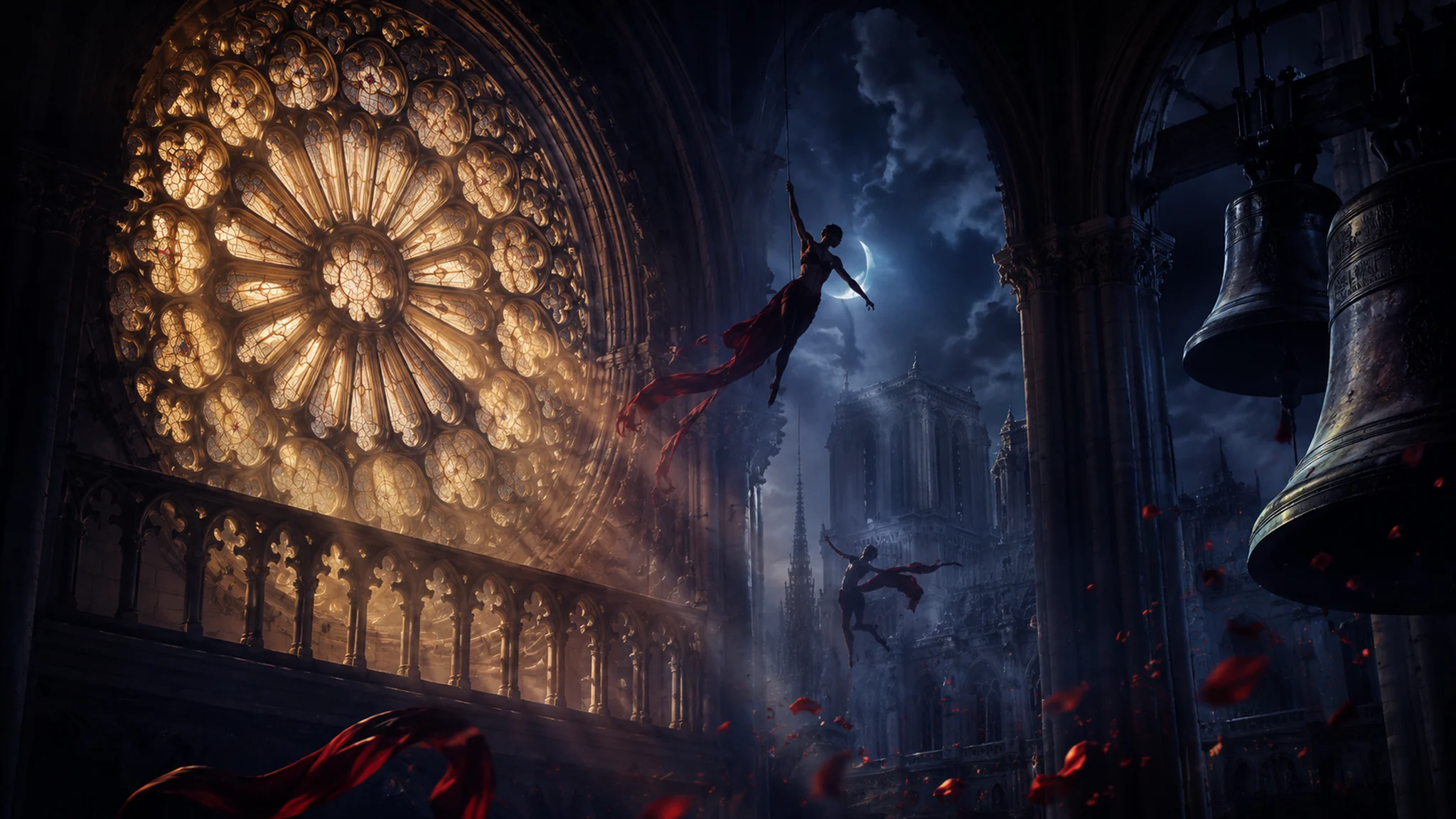
When Notre-Dame de Paris premiered at the Palais des Congrès in Paris on 16 September 1998, it redefined musical theatre across Europe. Based on Victor Hugo's timeless novel, with music by Riccardo Cocciante and lyrics by Luc Plamondon, the production proved that a musical did not have to follow the traditional Broadway or West End formula to become an international phenomenon.
Nearly three decades later, Notre-Dame de Paris continues to captivate audiences with its unforgettable music, poetic storytelling and breathtaking visual style.
In 2027, the original French-language production of Notre-Dame de Paris will come to Poland for the first time. The musical will be presented at ERGO ARENA in Gdańsk/Sopot on 19–20 February, followed by performances at TAURON Arena Kraków on 5–6 March.
This is not, however, the first production of Notre-Dame de Paris to be staged in Poland. A Polish-language production premiered at Teatr Muzyczny in Gdynia in September 2016 and ran for 180 performances, attracting 185,745 spectators. The 2027 tour marks the first Polish presentation of the original French-language production.
A Musical Unlike Any Other
Unlike most musicals, Notre-Dame de Paris unfolds almost entirely through song, creating an experience that bridges musical theatre and opera. Riccardo Cocciante's score blends pop, rock, classical influences and French chanson into a soundtrack that feels both contemporary and timeless.
Luc Plamondon's poetic lyrics explore universal themes of love, obsession, justice, prejudice, faith and social exclusion while remaining remarkably faithful to Victor Hugo's original vision.
Music That Reached Far Beyond the Stage
The iconic "Belle", performed in the original production by Garou, Patrick Fiori and Daniel Lavoie, became one of the most successful French-language songs ever recorded, introducing millions of listeners to the musical before they had ever seen it on stage.
Other unforgettable numbers including Le Temps des Cathédrales, Vivre, Florence and Danse mon Esmeralda remain concert favourites around the world.
A Legendary Original Cast
The extraordinary success of the musical owes much to its remarkable original cast.
Garou's unforgettable Quasimodo, Bruno Pelletier's heartfelt Gringoire, Hélène Ségara's vulnerable Esmeralda, Patrick Fiori's charismatic Phoebus, Daniel Lavoie's deeply conflicted Frollo and Luck Mervil's magnetic Clopin created performances that have become legendary in European musical theatre.
More than twenty-five years later, many fans still consider the original French cast recording the definitive interpretation of the musical.
Visual Storytelling at Its Finest
One of the production's greatest strengths is its striking visual language.
Instead of relying on elaborate scenery, the show combines choreography, acrobatics, lighting and symbolic staging to create a living Gothic world. Dancers and acrobats become extensions of the cathedral itself, transforming every scene into a work of moving art.
This innovative approach influenced many later European productions, demonstrating that imagination and movement can be just as powerful as large-scale technical effects.
Why Does It Still Matter?
The themes explored in Notre-Dame de Paris remain remarkably relevant today.
Quasimodo represents those judged by appearance. Esmeralda embodies freedom, compassion and vulnerability, while Frollo demonstrates how obsession and unchecked power can corrupt even those who believe they are acting righteously.
These timeless human conflicts continue to resonate with audiences of every generation.
Interesting Facts About Notre-Dame de Paris
- Victor Hugo considered the cathedral the true protagonist. The opening song, Le Temps des Cathédrales, reflects his belief that great monuments preserve history long after generations have passed.
- The musical became a global phenomenon. Since its 1998 premiere in Paris, Notre-Dame de Paris has been performed more than 6,000 times and seen by more than 16 million spectators, while its albums have sold more than 19 million copies worldwide.
- It entered the Guinness World Records. During its first year in Paris, Notre-Dame de Paris achieved record-breaking ticket sales, earning international recognition.
- The original cast launched international careers. Garou, Patrick Fiori, Bruno Pelletier, Hélène Ségara, Daniel Lavoie and Luck Mervil all became major stars after the musical's success.
- The 2019 fire at Notre-Dame Cathedral gave the story renewed significance. Following the devastating fire in Paris, many audiences rediscovered Victor Hugo's novel and the musical, appreciating them not only as works of art but also as celebrations of one of Europe's greatest cultural landmarks.
Looking Ahead to Poland
The arrival of the original French-language production in Poland in 2027 marks an exciting moment for theatre lovers across Central Europe. Presented with Polish subtitles, it offers audiences the opportunity to experience the musical in the language in which it was originally conceived.
Whether discovering it for the first time or revisiting a beloved classic, audiences will witness a production that has shaped European musical theatre for nearly three decades.
More than twenty-five years after its premiere, Notre-Dame de Paris remains a remarkable fusion of music, literature and theatrical artistry; it is a production that continues to inspire audiences around the world.
The success of Les Misérables, The Phantom of the Opera, and Notre-Dame de Paris is further proof that French novels have provided some of the richest source material in the history of musical theatre and will continue to do so.